
Quick Answer
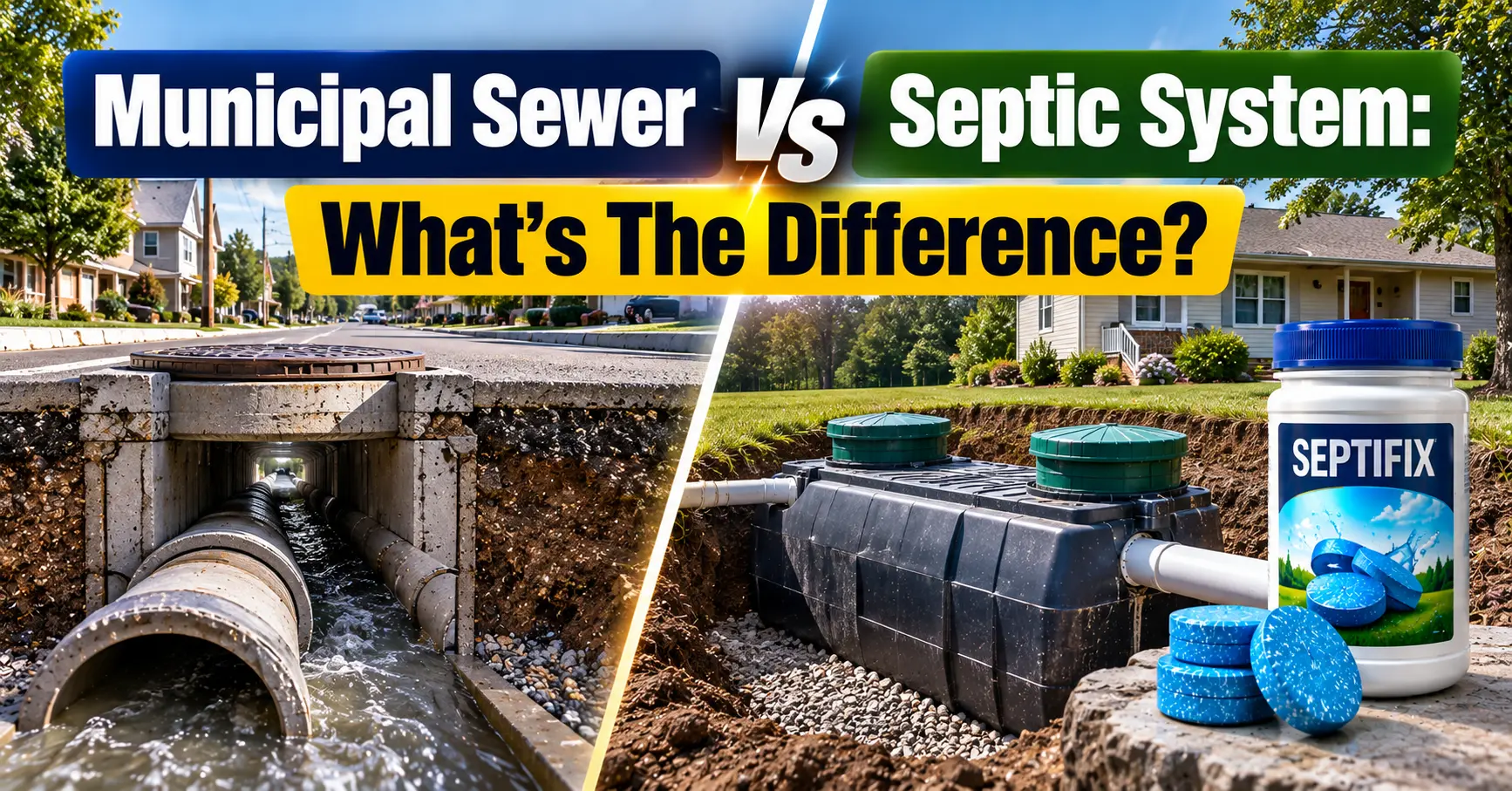
A municipal sewer system carries wastewater away from your home through a network of public pipes to a centralized treatment plant, managed and maintained by your local city or utility district, typically paid for through a monthly sewer bill. A septic system treats and disposes of wastewater entirely on your own property, using an underground tank and drain field, and it's entirely your responsibility to maintain, with no monthly utility bill but real periodic maintenance costs like pumping.
How To Tell Which One Your Home Has
- Check your monthly utility bills, a sewer charge (often bundled with your water bill) indicates municipal sewer service
- Look for a septic tank lid or riser in your yard, a visible cover, sometimes green plastic, sometimes concrete, is a strong indicator of septic
- Check your property's deed, survey, or county records, which typically state the wastewater system type
- Ask directly, your local water utility or county health department can confirm which system serves your specific address
How Municipal Sewer Works
With municipal sewer service, wastewater from your home flows through your internal plumbing into a public sewer line running beneath your street, which connects to increasingly larger pipes that eventually carry everything to a centralized wastewater treatment plant, operated by your city, county, or a regional utility authority. Treatment there involves a multi-stage industrial process designed to handle wastewater from thousands of homes at once, and the resulting treated water is typically released into a local waterway under state and federal environmental permits.
How A Septic System Works
A septic system handles everything on-site, right on your own property, with no connection to a public treatment system at all. Wastewater flows from your home into an underground septic tank, where solids settle and bacteria break down organic waste, covered in detail in our guide on what goes inside a septic tank. The resulting liquid effluent then flows out to a drain field, where it's naturally filtered through the soil before rejoining the local groundwater. This entire process happens on your individual lot, which is why septic systems are far more common in rural and lower-density suburban areas than in dense urban cores, where municipal sewer infrastructure is more practical to build and maintain.
See Current Septifix Pricing
Support the on-site biological process your septic system depends on.
Check Current PriceCost Comparison
| Factor | Municipal Sewer | Septic System |
|---|---|---|
| Ongoing Cost | Monthly sewer utility bill | No monthly bill, periodic maintenance costs instead |
| Major Repair Cost | Typically covered by the utility for main line issues | Homeowner's full responsibility, can be a significant expense |
| Routine Maintenance | Minimal homeowner responsibility | Regular pumping every 3-5 years, covered in how often to pump a septic tank |
| System Lifespan | Not applicable to homeowner | 20-40 years depending on maintenance, covered in how long does a septic system last |
Who's Responsible For Maintenance
This is one of the biggest practical differences and often catches first-time septic homeowners off guard. With municipal sewer, your responsibility generally ends at the point where your home's plumbing connects to the public line, everything past that point is the utility's problem to fix. With a septic system, you own the entire process, tank, pipes, and drain field, and there's no utility crew coming to fix a problem for you. This is exactly why proactive maintenance, covered in our septic maintenance checklist, matters so much more for septic homeowners than it does for anyone on city sewer, since neglect becomes entirely your financial and logistical problem to solve.
Why So Many US Homes Are On Septic At All
Roughly 20% of US households use septic systems, according to EPA estimates, concentrated heavily in rural areas, unincorporated counties, and lower-density suburban developments where running municipal sewer lines to every property would be prohibitively expensive relative to the number of homes served. This isn't a sign of an older or lesser system by default, plenty of relatively new, well-built suburban and rural homes across the US are on septic simply because of geography and local infrastructure economics, not because septic is inherently a fallback option.
What Changes If You're Moving From Sewer To Septic
- You'll need to actively track your own maintenance schedule, since nobody else is monitoring it for you
- Certain household habits matter more, like avoiding flushing anything besides toilet paper and waste, covered in flushable wipes and septic systems
- Budget for periodic costs like pumping, covered in septic pumping cost, rather than a predictable flat monthly bill
- Get familiar with your tank's location and access point, information a previous owner or your home inspector should be able to provide
For homeowners adjusting to septic for the first time, a consistent maintenance routine, including bacterial support between pumpings, is one of the simplest ways to build good habits early. You can read more in our Septifix Review 2026 and Septifix for new homeowners.
Frequently Asked Questions
Is it more expensive to have a septic system than city sewer?
It depends on the comparison. Septic has no monthly bill but requires periodic maintenance and eventual repair costs the homeowner fully bears. Municipal sewer has a predictable monthly cost but major line repairs are typically handled by the utility.
Can I switch from septic to municipal sewer if it becomes available?
In some areas, yes, if a municipal line is extended near your property, though this typically involves a connection fee and sometimes mandatory hookup requirements depending on local regulations.
How do I find out where my septic tank is located?
Check county health department permit records, ask the previous homeowner if available, or have a septic professional locate it during a service visit.
Why do rural areas rely more on septic systems?
Running municipal sewer lines to widely spaced rural properties is generally far more expensive per household than in dense areas, making septic systems the more practical and common choice outside cities and suburbs.
Final Thoughts
Municipal sewer and septic systems handle the same basic job, wastewater treatment, in fundamentally different ways: one centralized and utility-managed, the other on-site and entirely homeowner-managed. Neither is inherently better, they simply come with different cost structures and different levels of personal responsibility. If you're new to septic, understanding that the maintenance burden now sits entirely with you is the single most important mindset shift, and building a consistent routine early sets you up well for the years ahead.